
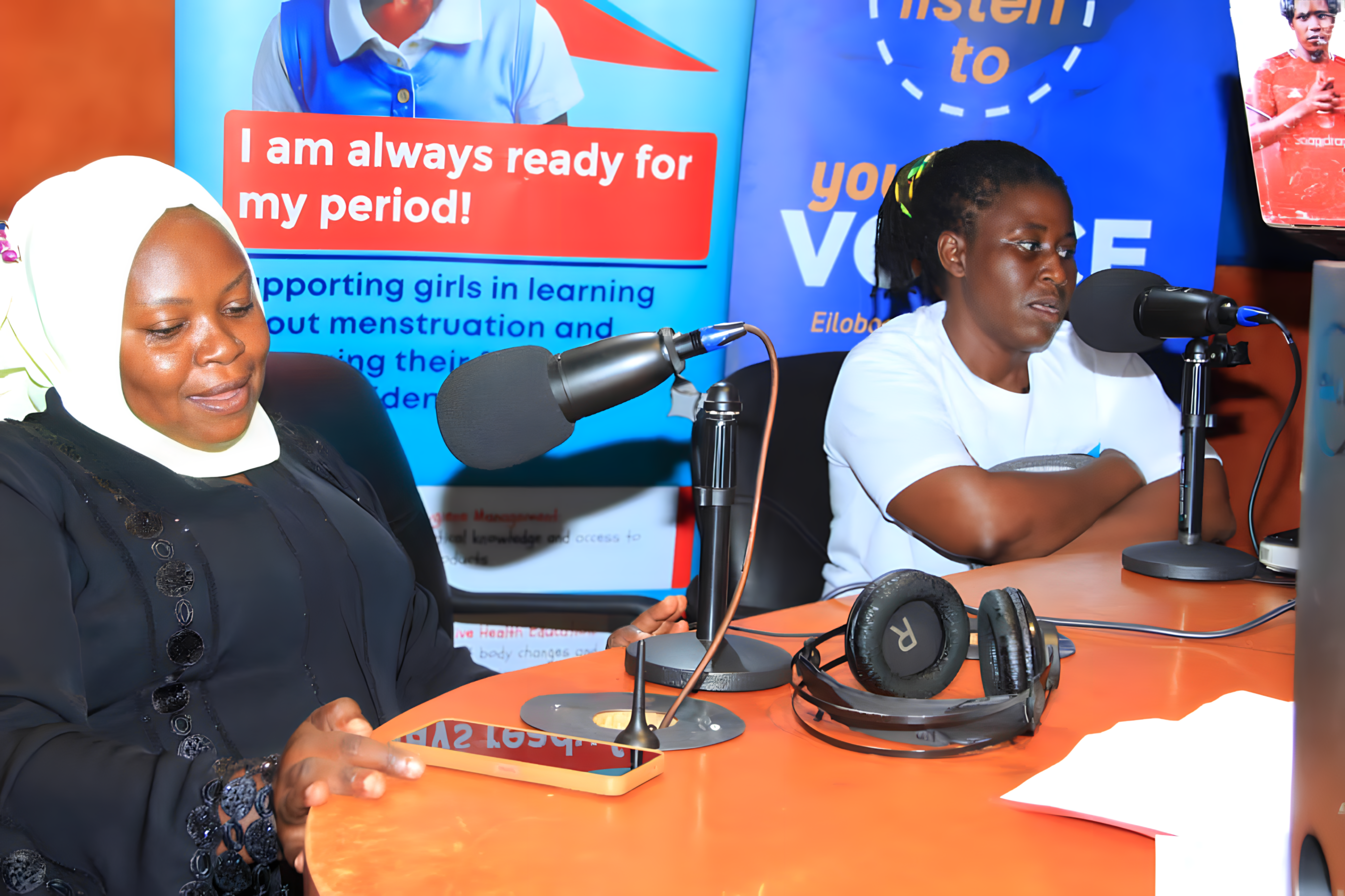
“See how 60 minutes are nothing?”
I laughed as the closing music faded and the microphones went silent.
Together, our Advocacy and Partnerships Manager, Lea Bwanika, our Outreach and Communications Officer, Vivian, and I had just listened to the very first episode of Ekiseera Ky’Omughala (A Girl’s Time) on Your Voice FM 92.5 Mayuge.
For weeks, we had planned every detail. We had debated topics, lined up guests, prepared educational messages, developed community vox pops (spontaneous opinions), organized prize hampers, and hoped people would tune in.
Then, suddenly, it was over.
One hour had disappeared in what felt like minutes.
What none of us realized then was that we had just begun something much bigger than a radio programme.
Over the next twelve weeks, listeners from villages across Mayuge District, and even beyond would call in with questions they had never asked before. Fathers would want to know how to support their daughters. Mothers would admit they had never known how to begin conversations about menstruation. Girls would share stories of fear, confusion, and shame surrounding their first periods. Health workers, teachers, community leaders, and students would all lend their voices to what had long been considered an uncomfortable topic.
By the end of the series, Ekiseera Ky’Omughala had become more than a weekly broadcast.
It had become a community conversation.
Why radio?

FlowReady was founded on a simple belief: every girl deserves to understand menstruation before her first period begins.
For about two years now, we have worked directly with schools and communities in eastern and central Uganda, preparing girls for menarche, challenging myths, engaging boys, and helping parents and teachers create supportive environments. But as our work grew, one question kept coming back to us.
How do we reach the thousands of families we may never have the opportunity to meet in person?

The answer, we knew as former Ugandan journalists (Lea and I), was sitting in nearly every home.
Radio.
Despite the rapid growth of digital media, radio remains one of Uganda’s most trusted and accessible sources of information, particularly in rural communities where internet access remains limited. In the Busoga region, where FlowReady works, approximately 73% of women and 82% of men listen to radio at least once every week. Those numbers represent far more than statistics. They represent conversations waiting to happen.
When we began exploring partners, Your Voice FM 92.5 stood out immediately.
Based in Mayuge District, the community-focused station broadcasts throughout Busoga and has built a reputation for tackling issues that matter to local people. More importantly, it offered something that aligned perfectly with FlowReady’s approach: interaction.
This wouldn’t be a lecture delivered over the airwaves.
Listeners would participate.

Every week would feature expert guests, community voices, listener call-ins, educational skits, a “Myth of the Week” segment, and questions answered live on air. To encourage participation, callers also stood a chance to win FlowReady gift hampers containing exercise books, pens, soap, sugar, a FlowReady T-shirt, and one of our reusable menstrual kits—complete with five reusable pads capable of lasting a girl for more than two years with proper care.

For many families living with limited resources, these prizes were more than giveaways. They were practical support and another way of demonstrating that menstrual health deserves investment.
Taking menstruation into living rooms
Our twelve-week series, broadcast weekly in Lusoga between April and June 2026, explored much more than periods themselves.

We began with the basics—what menstruation is, when it begins, and how girls can prepare for it. But as the weeks progressed, the conversations became richer and more ambitious.
Together with doctors, district health workers, teachers, youth leaders, community leaders, students, parents, and fathers, we explored the myths surrounding menstruation, the role of boys and men, parents’ responsibilities, father-daughter communication, early marriage, menstrual products, staying in school during periods, and ultimately reflected on everything communities had learned together over the previous three months.
Each episode was carefully designed around one goal:
Not simply to provide information, but to start conversations that continue long after the radio has been switched off.
“The phone lines wouldn’t stop”
Nothing prepared us for the response.
“I was particularly excited about how many callers we got,” Lea Bwanika remembers. “You could tell they had to be limited by the host. This is an issue that matters to people, even if it’s rarely talked about openly.”
She was right.
Almost immediately, the programme became one of conversation rather than presentation.
Questions poured in.
Stories followed.
Experiences that had remained private for decades suddenly became public—not because people were forced to speak, but because they finally felt safe enough to do so.
Throughout the series, Your Voice FM recorded an average of between eight and twelve live phone calls during every programme, alongside a steady stream of SMS and WhatsApp messages.
Behind every number was a person looking for answers.
Some wanted to understand painful periods.
Others asked whether fathers should discuss menstruation with their daughters.
Some wanted to know whether irregular bleeding was normal.
Others questioned cultural beliefs they had grown up accepting without ever having the opportunity to challenge them.
These weren’t simply medical questions.
They were windows into the everyday realities families face.
The men who surprised us
One of the greatest misconceptions surrounding menstrual health is that only women care about it.
Our listeners challenged that assumption almost immediately.
“What stood out most was that men called too,” Vivian recalls. “Fathers, brothers, and teachers wanted to understand how they can help. That told us the message is landing beyond just girls—it’s becoming a true community conversation.”
That observation echoed throughout the twelve weeks.
One episode focused entirely on men and menstruation.
Another explored father-daughter relationships.
Health workers encouraged fathers to become active participants rather than silent observers.
One guest, Nurse Claire, shared her own story of being helped by her father when she experienced her first period and challenged listeners directly:
“If you had a bad experience when you were young, please make sure your daughter does not go through the same.”
For us, these conversations mattered just as much as those with girls.
A girl’s experience of menstruation is shaped not only by what she knows, but by the people around her. Fathers, brothers, teachers, neighbors, religious leaders, and community elders all influence whether menstruation is met with support or shame.
The radio series gave every one of them a seat at the table.
But did radio actually work? In Part 2, Beyond the Broadcast, we go beyond the stories to look at the numbers, the questions listeners asked, the conversations that changed over 12 weeks, and what it all taught us about taking menstrual health education to the airwaves.
Leave a Reply